April Edition of the Kreston Pedabo Newsletter is Here!
Discover how evolving technologies, market shifts, and regulatory changes are transforming the Power & Natural Resources (PNR) and Information Technology & Telecommunications (ITT) industries. Get data-driven insights to future-proof your business.
This Month’s Must-Read Articles
1️⃣ How Market Research Drives Smarter Business Decisions
2️⃣ Enterprise Risk Management (ERM) in Nigeria: Building Business Resilience
Stay informed. Stay ahead. Dive into these insights and unlock growth opportunities for your organisation.
March Edition of the Kreston Pedabo Newsletter is Here!
In this issue, we explore latest trends reshaping the Power & Natural Resources (PNR) and Information Technology & Telecommunications (ITT) sectors. Stay ahead with actionable insights designed to empower your business in a fast-changing world.
This month’s spotlight article: is “Workplace Learning: How to Build a Future-Ready Workforce”, a must-read exploring the power of continuous learning to tackle tomorrow’s challenges and opportunities.
Let’s embark on this journey together and build a workforce ready to conquer the future
Welcome to the February Edition of the Kreston Pedabo Newsletter!
Discover the latest trends and developments in the Power & Natural Resources (PNR) and Information Technology & Telecommunications (ITT) sectors. This edition is packed with actionable insights to help your business stay competitive and future-ready.
Don’t miss our featured article, “Strategic Planning in Uncertain Times: How Businesses Can Stay Ahead in 2025.” Learn how organisations can thrive in an unpredictable world by leveraging resilience, strategic foresight, and adaptive planning—backed by real-world case studies.
Welcome to the inaugural edition of the Kreston Pedabo Newsletter for 2025!
In this issue, we present the 2025 Economic Outlook: Navigating Nigeria’s Economic Horizons. Dive into an in-depth analysis of Nigeria’s economic landscape as we address key challenges like structural inefficiencies, rising inflation, and a growing debt burden, while uncovering opportunities for sustainable growth.
We’re also excited to feature an actionable guide: 10 Practical Tips to Develop Your 2025 Sustainability Strategy and Boost Your Bottom Line. Discover how to align your business with sustainability goals and create long-term value.
Start your journey to success in 2025 with insights designed to help you thrive. Let’s make this a year of growth and transformation!
Welcome to the Latest Edition of the Kreston Pedabo Newsletter!
Stay updated with the latest trends in the Power & Natural Resources (PNR) and Information Technology & Telecommunication (ITT) sectors.
Featured Article: Sustainability in Nigerian Business Operations
Discover our strategic roadmap for integrating sustainability into Nigerian businesses. This article offers practical steps and successful case studies tailored for business leaders, policymakers, and industry professionals.
Explore these insights with us and drive sustainable practices in your operations!
We’re thrilled to welcome you to the latest edition of the Kreston Pedabo Newsletter! This month, we dive into the newest industry trends, news, and insights. Our featured article and case study, ‘Continuous Improvement in Strategy and Operations: A Detailed Roadmap to Success,’ provides valuable knowledge for business leaders, policymakers, and industry professionals to make informed decisions, drive growth, and stay ahead of the curve.
Strategic Planning for Successful Business Marketing
February 16, 2024
The success of any marketing campaign in today’s competitive corporate environment depends heavily on strategic planning. Businesses can overcome obstacles, make wise choices and decisions, and accomplish their objectives by carefully defining their marketing goals, identifying niche target audiences, and subsequently designing and implementing effective strategies to meet them.
The Significance of Goal Setting and Strategic Planning in Organisations
November 13, 2023
Antoine de Saint- Exupery, once said, “A goal without a plan is just a wish”. He postulated this based on the principle of life being a playing field for making plans designed to provide a tactical advantage and then working to ensure those plans come to fruition.
Goal Setting involves defining specific objectives that an organisation aims to achieve within a certain timeframe. These goals provide clarity, direction, and a sense of purpose for the individual and employees, helping them understand what they are working towards.
Strategic Planning goes beyond goal setting because it involves outlining the broader approach an individual or organisation will take to achieve set goals. It involves analysing the organisation’s strengths, weaknesses, opportunities, and threats; and then formulating tactics to leverage the strengths, address the weaknesses, seize the opportunities, and mitigate the threats. It helps in allocating resources effectively, making informed decisions, and adapting to changes in the business environment. It also ensures that everyone in the organisation is aligned towards a common vision and works together cohesively. In essence, while goal setting sets specific targets, strategic planning defines how the organisation will navigate its journey toward those targets, almost the establishment of operational systems and processes towards the goals to ensure the principle of Kaizen (continuous improvement).
Why is Strategic Planning important?
Businesses need direction and measurable organisational goals to work towards. Strategic Planning offers that type of guidance. It provides a roadmap that propels a business to its set goals. Without such guidance, there is no way to tell whether a business is on track to success or rolling downhill to failure.
The following four aspects of strategy development are worth attention:
The mission – Strategic planning starts with a mission that offers a company a sense of purpose and direction. The organisation’s mission statement describes who it is, what it does, and where it wants to go. Missions are typically broad but actionable. For example, a business in the education industry might seek to be a leader in online virtual educational tools and services. This goes beyond your ‘fixed’ organisation’s mission but certainly draws from it to break activities into smaller manageable goals for a financial year.
The goals – Strategic planning involves selecting goals; most planning requires the use of the SMART goal metric (Specific, Measurable, Achievable, Realistic, and Time-bound or other objectively measurable goals. Measurable goals are important because they enable business leaders to determine how well the business is performing against its overall mission. For example, Goal setting for educational business might include releasing the first version of a virtual classroom platform within the first quarter of a financial year or increasing sales of an existing tool by 30% quarter on quarter.
Alignment with short-term goals – It relates directly to short-term, tactical business planning and can help business leaders with everyday decision-making that better aligns their goals with their strategy. For example, for an educational business, leaders might choose to make strategic investments in communication and collaboration technologies, such as a learning management system or virtual classroom software.
Evaluation and revision – This There must be an iterative process in every endeavour. In these very dynamic times, businesses must be agile and periodically evaluate progress against the plan and make changes or adjustments in response to changing conditions on the go. For example, a business may seek a global presence, but legal and regulatory restrictions could emerge that affect its ability to operate in certain geographic regions. As a result, business leaders might have to revise the strategic plan to either collaborate with local entities within those jurisdictions, redefine objectives or change progress metrics all together to match possibilities.
What are the steps in the Strategic Planning process?
There is a myriad of different ways to approach strategic planning, and this depends on the type of business and the granularity required. Most strategic planning cycles irrespective of sector and scale can, however, be summarised in these five steps:
Identify – A strategic planning cycle starts with the determination of a business’s current strategic position. This is where stakeholders use the existing strategic plan – including the mission statement and long-term strategic goals – to assess the business and its environment. These can include a needs assessment or a SWOT (Strengths, Weaknesses, Opportunities, and Threats) analysis to understand the state of the business and the path ahead. These are internal and external assessments that help a company with clarity regarding its strategic options and they are driven largely by a realistic understanding of a business’s performance status vis-à-vis its larger operating environment.
Prioritise – Next, strategic planners set objectives and initiatives that line up with the company’s mission and goals and will move the business toward achieving its goals. There may be many potential goals, so planning prioritises the most important, relevant, and urgent ones. Goals may include a consideration of resource requirements – such as budgets and equipment – and they often involve setting timelines and business metrics or KPIs to measure progress.
Develop – This is the main thrust of strategic planning in which stakeholders collaborate to formulate the steps or tactics necessary to attain a set strategic objective. This may involve creating numerous short-term tactical business plans that fit into the overarching strategy. Stakeholders involved in this development will typically employ tools such as a constellation value map to help see how value truly flows within the sector and where best to play, a heat map could also be used to give you insights into where to compete geographically, as well as generate insights along other dimensions of granularity, amongst others. Developing the plan may involve cost and opportunity trade-offs that reflect business priorities.
Implement – Once the strategic plan is developed, it is then time to activate it. This requires clear communication across the organisation to set responsibilities, make investments, adjust policies and processes, and establish measurement and reporting mechanisms. Implementation typically includes strategic management with regular reviews to ensure that plans stay on track.
Update – A strategic plan is periodically reviewed and revised to adjust priorities and re-evaluate goals as business conditions change and new opportunities emerge. Quick reviews of metrics can happen quarterly or even monthly, depending on the granularity of expectations, and adjustments to the plan can occur accordingly. Stakeholders may use performance management tools such as the balanced scorecard to assess performance against goals.
Who does the strategic planning in a business?
When driven internally, in practice, a committee would typically be set up to lead the strategic planning process, and it is recommended that this committee include representatives from all areas within the enterprise who will work openly and collaboratively without the biases and personal agenda of own departments. The social side of strategy is a very key part of the strategy planning process and is responsible for the inaction and or failure of over 30% of initiatives across firms.
The committee researches and gathers the information needed to understand the organisation’s current status and factors that will affect it in the future. The committee should solicit input and feedback to validate or challenge its assessment of the information rather than have people emphasise one set of facts while downplaying others for the purpose of validation of personal agendas. One of the most successful methods is to create teams within the committee and force leaders to choose preferred strategic options and contest their validation. It becomes immediately obvious what the real pros and cons of each option is beyond biases as everyone becomes forced to be guided by facts. With this as a great starting point for Choice, leaders can further opt to use one of many methodologies or strategic frameworks, analysis or assessments to further drill into the best line of action toward the organisation’s strategic vision.
The committee creates benchmarks that will enable the organisation to determine how well it is performing against its goals as it implements the strategic plan. The planning process should also identify which executives are accountable for ensuring the benchmarking activities that will take place at planned times and how specific objectives will be met.
How often should strategic planning be done?
There are no uniform requirements to dictate the frequency of a strategic planning cycle. However, there are common approaches –
Quarterly reviews. Once a quarter is usually a convenient timeframe to revisit assumptions made in the planning process and gauge progress by checking metrics against the plan.
Annual reviews. A yearly review allows business leaders to assess metrics for the previous four quarters and make informed adjustments to the plan.
Timetables are always subject to change; timing should be flexible and tailored to the needs of a company. For example, a startup in a dynamic industry might revisit its strategic plan monthly, while a mature business in a well-established industry might opt to revisit the plan less frequently.
Now, let us look at a hypothetical case study for Goal Setting and Strategic Planning:
Case Study: XYZ Corporation – Goal Setting and Strategic Planning
Background: XYZ Corporation is a mid-sized technology company, specialising in software development. Over the past few years, the company has experienced moderate growth, but the leadership team is eager to accelerate market presence. To accomplish this, they have decided to undertake a comprehensive goal-setting and strategic planning process.
Key Players:
CEO – Elizabeth Olaniyi
CFO – Chinemeke Alozie
CTO – Sarah Hassan
VP of Sales – Olaitan Folorunsho
HR Director – Peter Chukwu
Current Situation:
XYZ Corporation operates primarily in the domestic market with a limited international presence. The Company’s products have received positive feedback, but there is room for improvement in customer retention and expansion into new markets. Financially, the company is stable but not achieving the desired growth rates.
Objectives:
Increase annual revenue by 25% within the next three years.
Expand into at least three new international markets.
Improve customer retention by 15%
Enhance product innovation and development processes.
Develop a diverse and skilled workforce to support growth.
Strategic Planning Process:
Assessment – The leadership team must conduct a thorough analysis of the Company’s strengths, weaknesses, opportunities, and threats (SWOT analysis) to gain a clear understanding of the internal and external factors impacting the business.
GoalSetting – Based on the assessment, the team will set specific, measurable, achievable, relevant, and time-bound (SMART) goals aligned with the objectives mentioned above.
Strategy Development – The team then has to devise strategies to aid the achievement of each goal. For instance, they plan market research, partnerships, and localisation efforts to expand into new international markets.
Resource Allocation – The CFO and CTO collaborate to allocate budget and resources effectively, ensuring that each strategic initiative has the necessary funding and talent.
Monitoring and Review – Regular performance metrics are established to monitor progress toward the goals. Monthly and quarterly reviews are to be held, to assess achievements and make adjustments as needed.
Employee Development – HR Director, Lisa Davies plays a critical role in developing employee training programs to enhance skills and promote diversity and inclusion.
Outcome:
Annual revenue increased by 30%
The Company expanded into five new international markets through local alliances and have established a partnership to roll-out local outlets in French speaking countries over the next 5 years.
Customer retention improved by 18%
The product innovation process became more efficient, resulting in the launch of two highly successful new products.
The workforce became more diverse and skilled, contributing to innovation and productivity.
XYZ Corporation’s strategic planning and goal-setting process whilst rigorous and time consuming was designed to beat the market and take it to the upper quintile of the power curve. This was able to facilitate its ambitious growth drive and positioned the company as a competitive player in the global market. It is important to highlight that some opportunities can only be identified or invalidated through this thorough process, as you find that some opportunities that seemed obvious are in actual fact, not real bets and would cost more than they are worth. Similarly, some fewer known opportunities can turn out to be the big bet.
Conclusion
Effective Goal Setting and Strategic planning has many benefits; it forces organisations to stay aware of the future state of opportunities and challenges. It also forces them to anticipate risks and understand what resources will be needed to seize opportunities and overcome greater scale issues.
It also gives individuals a sense of direction and marshals them around a common mission, whilst creating standards and accountability. Strategic planning can enhance operational plans and efficiency and helps organisations limit the time spent on crisis management, where they are reacting to unexpected changes that they failed to anticipate and prepare for.
Goal Setting for businesses is typically an activity that occurs towards the start of a financial year following an assessment of the previous period’s performance, so now is a great time to begin to make those assessments and plans towards a new financial year.
Work and learning are inseparable concepts hence, workplace learning can be described as the process through which skills are developed and knowledge transferred to boost effectiveness, efficiency, and productivity across all activities within the workplace. It is further described as the informal acquisition of skills, knowledge, and experience through on-the-job activities and tutelage. This process of learning can be imbibed through interactions with peers, seniors, and subordinates and by engaging in work activities that help people to develop their skills and capacity, and improve their performance on the job.
According to a McKinsey report, among the great resignations and great reshuffles, lack of career development and advancement is the leading reason for leaving a job, and while 87% of organisations know they have a skills gap or will have one in the next few years, only 40% of employees say their company is operating at high efficiency.
The importance of educating and upskilling the workforce has never been greater than it is now. Learning in today’s workplace is one of the most essential tools in the improvement of workers’ competency, which assists them to adapt to change and solve current problems. With the advent of technology, changes in the demography of the workforce, and dynamic economies worldwide, skilled employees, transferrable knowledge, and exceptional leadership have become irreplaceable factors in the need to establish workforce competency.
Reshaping Workplace Learning
Learning and development in the 21st century must take a different approach from training in the past, and organisations must be prepared for these paradigm shifts so as to effectively equip their employees with the skills required to be agile in this ever-changing environment.
According to Abby Lewis, Senior Product Manager for Harvard Business Review [Corporate Learning in an interview with HR Daily Advisor], one of the most common missteps made by organisations is simply not prioritising employee development. “It is not enough to send people to train once a year,” says Lewis. “Learning is now part of the modern workplace contract, and it should be a part of workplace culture, as workers expect investment in the skills, knowledge, and experiences that will keep them productive and employable.” She pointed to a recent Degreed/Harvard Business Review Corporate Learning report, which found out that managers were not providing the guidance as consistently as learners required, as only 39% of managers gave regular feedback on performance or skills, and only 38% held periodic check-ins with their teams.
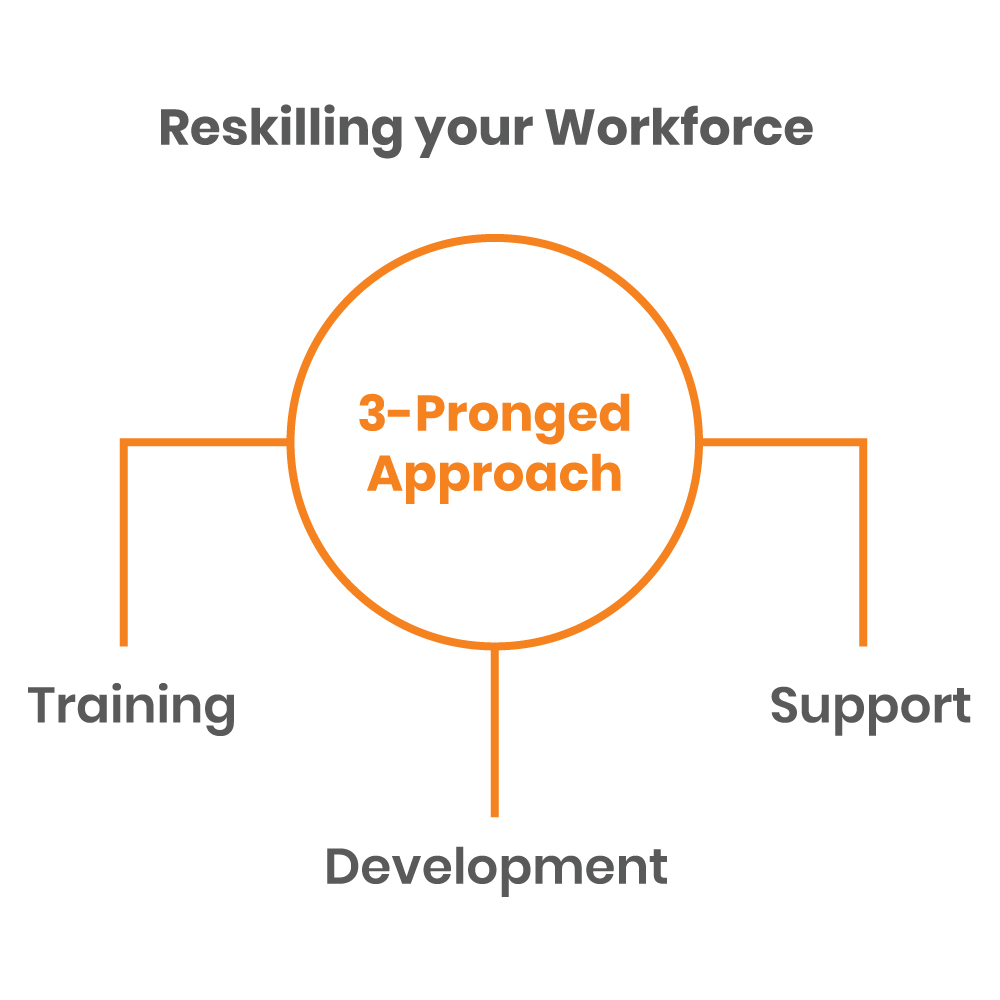
The old learning system which one could say was effective, if only static, often involved designating official trainers for specific training periods, whereas a modern approach to learning in the workplace is agile in nature, and acknowledges and considers barriers that many employees face when participating in learning. Identifying the diverse needs of the learners is essential for employers, to look at incorporating the skills and experience of managers in driving the employee development process. With new technologies and digital tools, employees can learn from anywhere, and at any time which focuses on more strategic learning that includes hard skills and soft skills. In doing this, it is essential to implement a learning and development strategy to define what workplace learning means within the organisation. This is where Upskilling and Reskilling play their parts, globally, with business leaders and employees agreeing that they are top priority. The former is focused on training employees to become more knowledgeable and develop new competencies relating to their current position, while the latter is about equipping workers to move into new roles within an organisation. To be able to effectively harness their power, workplaces must have effective annual staffing plans guided by skills and competency assessments. Organisations indeed, must adopt and expand employee development strategies to create a more adaptable workforce and achieve company objectives in today’s world of work, where the need for upskilling and reskilling has grown exponentially.
Strategies for Effective Workplace Learning
Identify Skills gap
In practice, many employers seldom carry out periodic Needs analysis or skills assessments until a gap in talent becomes obvious and begins to affect the effective operations of the company, and at that point, it is often a race against time, and the focus of most HR business partners is diverted to promptly filling talent gaps. However, we find that a more proactive way to manage this potential outcome is to hold scheduled assessments so as to appropriately plan the company’s workforce needs. Also, input into this exercise with regard to current employees is the performance reviews which ideally feed into the skills gaps that form a critical part of the overall assessment exercise. The intention is not to focus on the current needs but to be able to plan for future skill needs as well as talent gaps. Some of these processes required to gather the necessary data can be as simple as staff pulses and surveys, research on the future of work in particular fields, performance reviews of individuals and teams, and feedback from managers and employees to validate the choices made around the relevance of identified learning need to the organisation, as well as where to focus learning efforts. Once the skills gaps have been identified, the organisation can determine the training and development needs required to address them.
Develop Learning Paths for Each Employee
Developing customised learning for employees in a Learning Management System (LMS) to meet the individual needs, preferences, and learning styles of each learner has diverse advantages which can lead to increased engagement and motivated learning. Customised learning such as e-learning courses, webinars, workshops, coaching, and other learning modalities, can be done through a series of learning activities that are tailored to their needs, leading to achieving the goals set. As against the one-size-fits-all approach to learning, customised learning pathways allow employees to progress through a series of learning activities that are tailored to their needs. Developing learning paths for employees enables them to share what they would like to learn and— prepare them for new opportunities and for long-term growth in the firm.
Think Processes, Not Events
According to Ebbinghaus (1850-1909), a German psychologist who conducted experiments on human memory, his forgetting curve theory states that people forget 40% of what they have learned in 20 minutes and 77% of what they have learned in six days. This can be attributed to the fact that our brains are constantly absorbing information, and unless this information is used on a regular basis, it will be lost. Hence, what is clearly the best approach for which learning can be sustained is that it be treated as a process, a continuum, rather than the conventional approach where it is but most designed as an event. When we internalise the new skill acquired given its relevance to our daily activities, that is when we can say we have actually learned something. Learning as an event, whether it is 2 hours or 2 days without the benefit of internalising, creating time to revisit the techniques and think about how to utilise them on the job is rarely effective.
Ask Employees for Input and Feedback
An integrated learning program can better meet the needs of employees if their voices were incorporated into the process. Leaders need to work closely with management and employees to understand employees’ training needs and align them with the organisation’s objectives, which can be done via surveys, questionnaires, reviews, or active assessment projects such as a Needs Analysis. A training needs analysis will help to identify skill gaps and the various and best methods required for the training. It is also important that employers actively communicate the learning intentions and strategies that will be put in place to support employees to add more value and increase their potential for growth in the workplace.
It is essential to measure the effectiveness and impact of the programs on employee performance and productivity regularly by requesting feedback – self, peer, boss, and subordinate. Other metrics that can adequately inform the performance of the interventions could include retention, error rates, and customer satisfaction survey, amongst others. The organisation can reshape the learning initiatives to ensure that they create meaningful, engaging development opportunities that continue to meet the needs of the organisation and its employees in the long term.
Why is Workplace Learning Important?
Better Employee Retention
In today’s world of work, employees demand employers who are willing to offer them opportunities for learning and development which will enable them to excel in their roles and grow to take on more responsibilities. According to LinkedIn’s Workplace Learning Report, 2022, having opportunities to learn and grow is now the number 1 factor that people say defines an exceptional work environment.
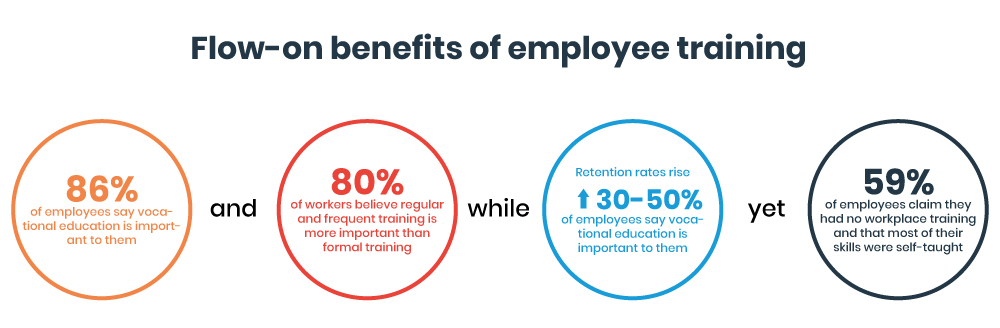
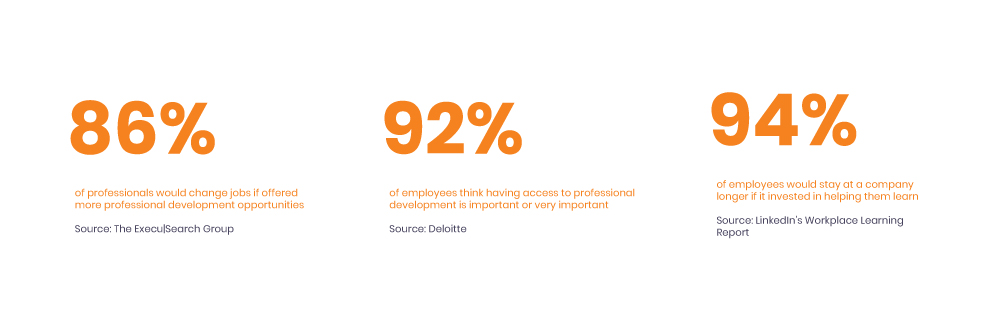
Recent research findings show that professional development is critical to employees: 86% of professionals would change jobs if offered more professional development opportunities, 92% of employees think having access to professional development is important or very important and 94% of employees would stay at a company longer if it invested in helping them learn according to LinkedIn’s Workplace Learning Report 2019.
Enhancing Employee Performance
A large dependence between training and employee performance has led to a constant change in training strategies and supplementing them with new elements, in response to the changing needs of employees. In a study of more than 3,100 U.S. workplaces, the National Centre on the Educational Quality of the Workforce (EQW) found that on average, a 10 percent increase in workforce education level led to an 8.6 percent gain in total productivity. But a 10 percent increase in the value of equipment increased productivity by just 3.4 percent, showing a higher increase in the rate of productivity as a result of being more learned.
Supplementing internal training courses with external courses, financing or co-financing studies or international certificates, offering participation in industry conferences, and providing free access to leading educational platforms, coaching, and mentoring may seem like an extremely costly strategy, but the potential benefits may exceed their value many times over. However, each company’s and its employees’ needs must be carefully considered, along with the potential impact on employee performance.
Conclusion
Reshaping what workplace learning means to your organisation is important in staying competitive in today’s agile world of work. A comprehensive training and development program, designed for employees within an organisation in response to a detailed assessment, can help organisations retain top talent, and increase productivity. Organisations should ensure that their leaders are actively involved in the development process and leaders should promote a culture that fosters a commitment to learning and development.
FINANCE ACT 2023: COMMENCEMENT DATE DEFERRED TILL 1ST SEPTEMBER 2023
July 7, 2023
President Bola Ahmed Tinubu on Thursday 6 July 2023, signed four (4) Executive Orders, among which is the Finance Act (Effective Date Variation) Order 2023. These Orders primarily vary recent amendments to laws which involve the imposition of taxes and custom duties.
Highlights of the Executive Orders
The Executive Orders have made the following variations to existing tax provisions:
Deferment of the Commencement Date of Finance Act 2023: Recall that the FA 2023 was signed by the former President on 28th May 2023, with its effective date backdated to 1st May 2023. The new effective date of the recently passed Finance Act 2023 has now been postponed till 1 September 2023. The rationale behind this is to allow for the 90-day notice requirement in the event of changes in tax laws, as contained in the 2017 National Tax Policy document.
Extension of Implementation of the Customs, Excise Tariff, Etc. (Variation) Amendment Order 2023: This Order was recently signed with the commencement date set as 27 March 2023. Via this new action, the President has now suspended its implementation till 1st August 2023, in line with the National Tax Policy.
Suspension of 5% Excise Tax on Telecommunication Services and Locally Manufactured Goods: Further to the extension of the implementation of the Custom, Excise Tariff Order, the re-introduced excise duty on telecommunication services and locally manufactured goods has now been suspended accordingly till the new commencement date.
Suspension of Green Tax: Recall that a ‘green tax’ was newly introduced via the Customs, Excise Tariff, Etc. (Variation) Amendment Order 2023, to be imposed on single-use plastics. This now stands suspended following the pronouncement of the President.
Suspension of Import Tax Adjustment Levy on Specific Vehicles: The President has suspended the application of the recent increment in import duty on named vehicles, and thus the old rates are still expected to apply.
Our Comments It is laudable that the directive of the National Tax Policy is being adhered to, by ensuring that taxpayers have ample notice before amendments to tax laws are implemented. This is especially commendable as retrospective commencement of laws often prove harmful from a business perspective, which ultimately threatens the ease of doing business in the country. The provision of the new Executive Orders will help businesses and other relevant stakeholders make the necessary business decisions which are most favourable, whilst still complying with the provisions of the relevant laws.
We therefore urge taxpayers to take note of these changes and the attendant effects on their businesses, pending further guidance from the appropriate quarters.